
Tuesday October 20, 2026 | Past Shows | Neal
Movie Review: Heat of Madness (2026)
By The Mink
This movie does not have a release date yet.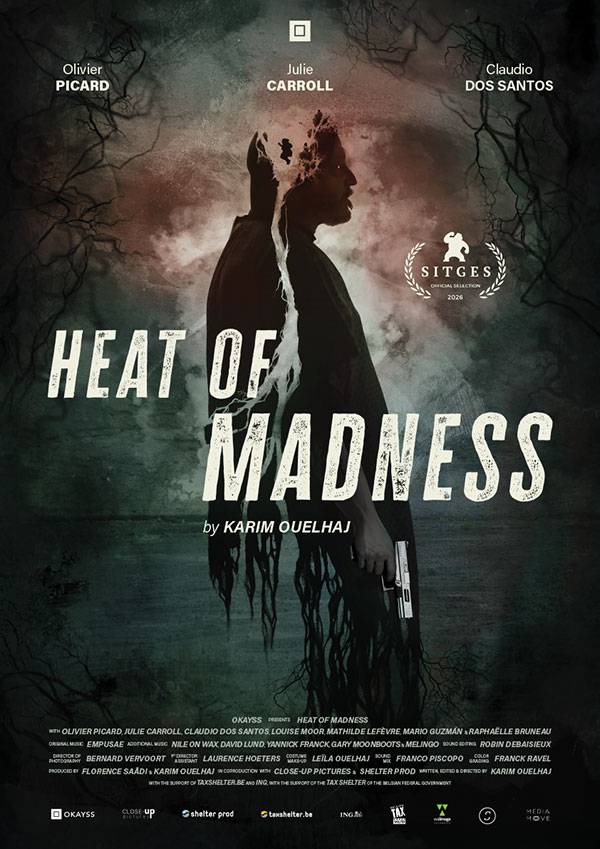
A quick note about spoilers: I won't reveal the film's central mystery or how it resolves, but I will discuss some of its narrative structure, tonal shifts, and a few specific scenes. Part of the film's appeal is watching its narrative unravel, so anyone wanting to go in completely blind may want to stop reading here.
There's something interesting about a movie that encourages you to construct explanations only to undermine them, but there's also a fine line between deliberate ambiguity and simply leaving the audience confused. I can't say with certainty which side of that line “Heat of Madness” falls on, and I suspect different viewers will have very different reactions to it.
There is also a bit of tonal whiplash because the first half of the movie is a violent revenge saga, with a bit of dark humor thrown in, like when Scola bullies a man for his sandwich, only to throw it back at him when he realizes it’s vegetarian. And then, for no particular reason, a character starts… farting out apples.
That’s not me toning down the language because it’s caca. She farts out literal apples.
Before this point, the film had been what I’d call “action movie grounded” (a recognizable reality, albeit one where a middle-aged man guns down a slew of thugs with a gun in each hand), and then a particular character farts, and an apple falls out of her dress, moving the movie into the absurd and surreal. For the life of me, I can’t tell if there's a deeper metaphor here or if it’s just an excuse for juvenile humor. Considering how much of the movie invites interpretation, I found myself wondering whether I was supposed to be looking for meaning in the farting apples, too. I’m pretty sure you could remove the whole bit without changing the movie much.
If this movie gets traction, I expect Ouelhaj to be hounded endlessly with the question, “Why did you make the lady fart apples?” But he also dedicated a lot of time in his movie to a woman farting apples, so my sympathy is limited.
Despite the whole apple shtick, I think “Heat of Madness” is worth checking out if you're a fan of genre-bending films and puzzle-box narratives with no easy answers, but even then, your mileage may vary. I can't say I've completely unraveled what Ouelhaj is doing, and I'm not entirely convinced every mystery has a satisfying explanation. Still, the performances and visuals are strong enough that I found the experience worthwhile, even in those moments when I wasn't sure what to make of it.
I was fortunate enough to get a sneak peek at Belgian director Karim Ouelhaj’s most recent film, “Heat of Madness,” starring Olivier Picard as Scola, a brutal gangster seeking vengeance for a betrayal following a diamond heist. However, as the movie progresses, it starts to morph into something beyond a tale of revenge.
At first, you think you’re watching a character study by way of a gangster movie, and not a particularly grounded one. Think of a Jason Statham or Nicolas Cage direct-to-video action flick. Not knowing the direction this film was going, I thought it was one of those types of movies, and I don't mean that as a criticism. I was hooked from the beginning and completely invested once it's discovered that the diamonds are missing.
Picard even gets his Statham/Cage action movie moments, with Scola firing a gun in each hand and mowing down those who wish him harm as his enemies’ bullets miss him by a mile. It’s a mix of kind of awesome and kind of ridiculous, as Scola is middle-aged, overweight, and on the short side, but still a terror every step of the way.
But as the film progresses, we discover we are watching a metanarrative akin to the work of Ouelhaj’s Belgian contemporaries Hélène Cattet and Bruno Forzani (“The Strange Colour of Your Body’s Tears,” “Reflection in a Dead Diamond"), where film genre tropes and conventions are used to comment on the medium itself. While Cattet and Forzani tend to deconstruct genre through cinematic language, Ouelhaj appears to be doing something a little different, using those conventions to explore Scola’s subjective reality.
We are not necessarily viewing Scola as a criminal, but the idea of Scola as a criminal. Is this how Scola sees himself? Is he actually someone else processing an unrelated trauma that feels like a diamond heist gone bad? The distinction becomes increasingly important as the film progresses, challenging our understanding of what we're actually watching. But if
he's not a criminal, what are we actually viewing?
“Heat of Madness” is anchored by two strengths: the performances of its cast and the stunning cinematography of Bernard Vervoort.
Olivier Picard, in particular, gives a go-for-broke, game-for-anything performance, making it believable that extreme acts of cruelty and extreme displays of tenderness and vulnerability can be aspects of the same person. When in gangster mode, Picard reminded me of Joe Pesci and Bob Hoskins in similar roles. What Scola lacks in physical intimidation, he makes up for with simmering rage, reducing larger men to nervous wrecks when he starts interrogating them. But when Scola is with his wife or group of friends, he’s an average Joe, outwardly unremarkable, with the ability to just blend in with a group. At first, you think we’re seeing the contrast between Scola at work and Scola at home, but as the film progresses, what we are viewing is a tad more complex.
I also want to give special attention to Vervoort’s photography, which gives us some truly beautiful scenes. “Heat of Madness” could have remained a generic gangster movie about a heist gone wrong and still would have been notable for its use of wide shots. What particularly drew me in was his use of scale and environments, especially landscapes and cloudy skies. Even scenes involving nothing more than characters walking from one place to another become visually engaging because of how the figures are positioned within their surroundings. There's a sense of space that makes the environments themselves as interesting to look at as the people occupying them. This isn’t to take away from the other scenes shot differently, but if Vervoort were to film anything with this kind of consistent emphasis on wide shots, that alone would be enough of a selling point for me.
As for criticisms, “Heat of Madness” is intentionally challenging, and it is just that, for better or worse. Mysteries are presented, and solutions are withheld. I think by the end I had a grasp of what Ouelhaj was doing, but I also know I could be wrong. It could be that my metanarrative analysis is just me trying to make sense of a confusing film. For example, I was sure a character was a representation of Scola’s unborn daughter as an adult, but that theory was proven very untrue not long after I came up with it.