
Sunday February 8, 2026 | Movie Reviews | Neal
Wormtown
A Review by Aaron Barrocas
“There’s no safe place. There’s no science left. There’s just them. And all they want is for you to be like them. And once you’re like them, there’s no going back.”
Wormtown is a visually powerful, texture-filled feature directing debut from television and film industry veteran Sergio Pinheiro.
The town is Ashland, Ohio. The time is the very near future. Or maybe the present and it just hasn’t come our way yet. The residents of Ashland have fallen victim to a parasitic worm that reproduces rapidly and takes control of all one’s organs. They rot the host from the inside, until the body the victim once knew is simply a container for millions of worms – even if the brain is still functioning and trying to maintain normalcy. The hosts become nocturnal, as their parasitic worms cannot tolerate the sunlight, and their pain becomes the host’s pain. Yet this is not what the movie is about.
Like any well-written apocalyptic movie, Wormtown is about how society reacts to the existential threat - how it brings out the best in some, and the true in others. In the case of Ashland, Ohio, the reaction is a massive power grab by Mayor Joshua (Jim Azelvandre), as he uses a combination of religion, media conditioning, and classic fascism to convince the town that the infected have been enlightened, and it is their responsibility to spread the illness until nobody is left unafflicted.
Hastily deputized civilians, often despite having no law enforcement training, become “ranchers”, responsible for harassing, assaulting, and ultimately converting those who have not yet become hosts to the parasite.
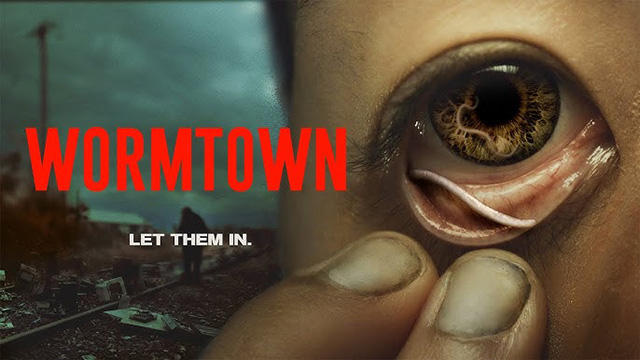
The movie opens (quite necessarily) with a large amount of world-building, some of which is particularly horrific, as we learn what awaits the afflicted should they venture into the sunlight. In case the upsetting eye-stuff poster wasn’t a hint, there is serious body horror in this film, and in the first act we move from traumatic incident to traumatic incident as the horrible world our heroes live in is established.
We meet Rose, Kara, and Jess, who have remained healthy to this point. Jess (Caitlin McWethy) is to become our protagonist; her partner Rose (Emily Soppe) and roommate/friend Kara (Rachel Ryu) both have vital roles in the narrative. Forgive the ambiguity, as I always attempt to minimize spoilers.
The story progresses from the first minute until the last, with no stagnation. We are asked to constantly build upon our understanding of the situation to keep up. Sergio Pinheiro’s stylized directing of Andrew James Myers’ darkly-toned script does not make for a passive viewing experience. We are constantly challenged with the question of why the thing we’re seeing is happening, and occasionally asked to draw our own conclusions, which I always appreciate as a viewer.
Early on in the movie Kara and Jess split ways, and their stories develop concurrently throughout the remainder of the film. Kara finds support in her newfound friendship with Alice (Maggie Lou Rader), an afflicted mother mourning the recent loss of her young son, heavy with the weight of the life she has experienced. On the other end of the spectrum, Jess befriends Susanna (Madison Murrah), a young Amish woman desperate for knowledge of life beyond the limits of her small world. These four women become the driver and soul of the movie, each of them with different perspectives and different goals, intersecting at the greatest crisis of their lives. McWethy, Ryu, Murrah, and Rader skillfully carry the weight of the film, ensuring that the movie is a series of personal journeys, as opposed to a sci-fi or monster movie. But it is also those things.
The cast is rounded out by memorable performances by Jim Azelvandre’s unhinged Mayor Joshua, A.J. Baldwin’s tough-as-nails “The Dudette”, Louie Kurtzman’s skeptical Hans, and Jordan Mullins’ overzealous Rancher.
This is a big-concept, small budget movie, and Pinheiro manages that balance brilliantly. Somewhere between religious ceremonies, home raids, torturous surgeries, frightening metamorphoses, brainwashed cult members, and a Bill & Ted obsessed Amish woman, we are given a rebellious, almost punk vibe, at times personified by Jess herself. This movie has a clear perspective, and that perspective is more than a little bit angry and concerned. Pinheiro’s carefully told tale draws clear influence from Fincher, Lynch, perhaps George Miller, unquestionably Romero, and of course Cronenberg (both of them) are always remembered during particularly effective body horror movies. Probably several more, as Wormtown was crafted with care by a filmmaker who clearly loves the language he’s speaking.
The locations feel dirty, industrial, abandoned. Viewers can smell each space. This is helped tremendously by the painstaking sound design, immersing us in every environment.
Peter G. Adams composed the sparingly used, stark score. The music quietly supports the film, never overpowering, and never bringing attention to itself. On their own, the tracks are occasionally beautiful compositions, but in the context of the film, they cause chills and tighten one’s stomach.
Interestingly, this movie was initially released on the same day as the first episode of Apple TV series Pluribus, a much larger scale production similarly exploring the plight of a few unaffected individuals in a society where a life-changing illness has been normalized. Pluribus gained tremendous traction, rightfully so, and those who enjoyed the series may take an interest in Wormtown’s grittier take on the theme. The fact that this concept is so pungently in the ether may hint that larger conversations should be taking place.
This movie won’t be for everybody. It has true body horror and more worms than you have ever seen in just over 90 minutes. It requires constant work on the part of the viewer; second screen viewers won’t keep up as this is a phone face-down kind of flick. There is a very clear and unsubtle viewpoint being communicated. But for those who can handle the rougher stuff, and know what genre movies are meant to be, this is a good one. If you understand that sci-fi has always been a podium with a mic, and that gore has always been a raised voice from that podium, you’ll appreciate what this movie is doing and how it’s doing it.
Wormtown is on AppleTV, Amazon Prime, Google Play Movies, and also Crankeduptv.com – the production company behind the film. I strongly recommend taking a look at that site, and viewing the movie there, to fully support the independent filmmakers behind Wormtown, so that they may continue creating powerful indie genre films.
Aaron Barrocas is an award-winning screenwriter, filmmaker, and editor living in Los Angeles. He has spent the past 25 years as an active part of the entertainment industry. AaronBarrocas.com